
Paper Packaging · Materials & Sustainability
Molded Fiber Packaging: Recycling Reality, Microplastics and the Shift to High-Performance Fiber
Modestia Works EP10 looks beyond the simple “paper versus plastic” debate. The video connects recycling performance, microplastic concerns, molded fiber technology and barrier design to a broader question: what does it take to make fiber packaging genuinely useful at scale?
Video: Modestia Works EP10 on YouTube · 8 min 35 sec
The short answer: why molded fiber is gaining attention
Molded fiber is attracting attention because packaging decisions are increasingly judged across several dimensions at once: material origin, recycling reality, plastic pollution, barrier performance and the ability to run reliably in industrial production. Fiber-based packaging can reduce dependence on fossil-based plastics in suitable applications, but that does not mean every fiber package is automatically recyclable, compostable or fit for demanding food-contact use.
The useful question is not whether paper is “better” than plastic in every case. It is whether the complete packaging system—material, additives, process and end-of-life route—fits the intended application.
1. Recycling performance depends on both material and system
One of the clearest comparisons in EP10 comes from U.S. EPA packaging data. In 2018, the reported recycling rate for paper and paperboard containers and packaging was 80.9%, while the rate for plastic containers and packaging was 13.6%. Those figures describe the U.S. municipal waste system in that year, not a universal rule, but they show how differently packaging materials can perform inside an established collection and recycling network.
For molded fiber, this matters because “fiber-based” alone does not determine end-of-life performance. Coatings, barrier chemistry, food contamination, product construction and local recycling infrastructure can all affect whether a package is actually recovered.
2. Microplastics make packaging an environmental persistence question
Plastic waste is not only a disposal-volume issue. Microplastics have been reported across marine, freshwater, soil and atmospheric environments, and have also been detected in the human body. The health implications are still being studied: the World Health Organization continues to emphasize significant evidence gaps and the need for better exposure and risk data.
That uncertainty is a reason for precision, not exaggeration. The strongest case for reducing unnecessary plastic use is based on persistence, leakage and lifecycle management—not on claiming health outcomes that science has not yet established conclusively.
3. Molded fiber is moving beyond basic protective packaging
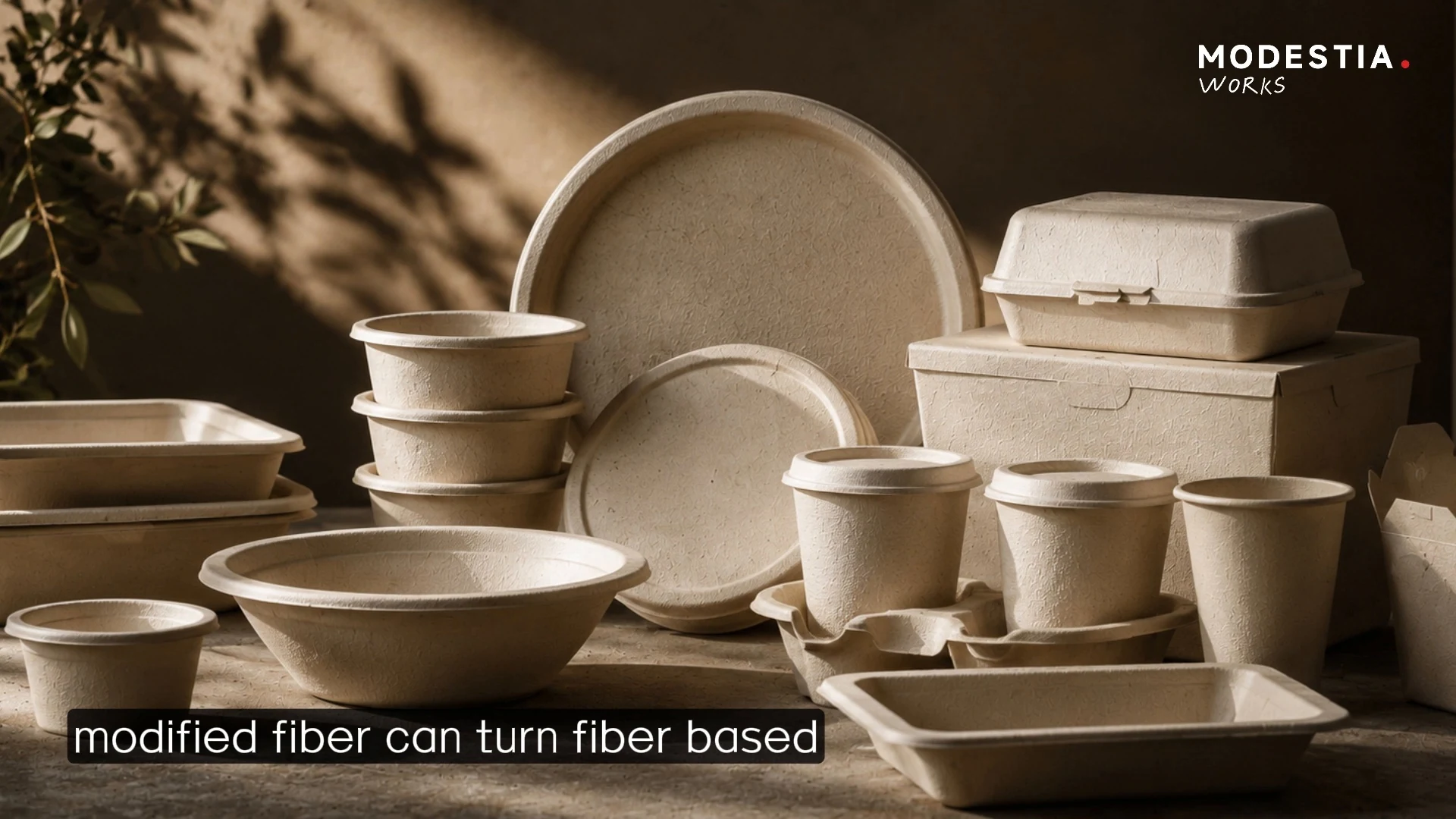
Traditional molded fiber was often associated with egg trays, protective inserts and low-complexity disposable products. The technology is now moving into food-service packaging, trays, bowls, lids, compartmented formats and other three-dimensional structures that require better surface quality, dimensional control and functional performance.
This shift changes the role of chemistry. Once a molded fiber package must hold hot food, resist oil and grease, tolerate water contact or maintain mechanical integrity through transport, the substrate alone is no longer enough. Fiber engineering and functional additives become part of the package design.
4. Barrier chemistry determines where molded fiber can actually be used
Untreated cellulose fibers readily interact with water, oil and grease. For many food-contact applications, practical performance depends on introducing a barrier system that matches the required temperature, contact time and production process.
Wet-end additives can build barrier functionality into the fiber system before forming, which is particularly relevant for complex molded geometries such as side walls, grooves and compartment trays. Surface-applied systems provide another route where post-forming treatment is preferred. The right approach depends on the end-use target and the manufacturing line.
For manufacturers evaluating PFAS-free wet-end barrier chemistry, RETERRA RT901 is one option in XIAOJU's molded fiber portfolio. Broader selection logic is covered in our Molded Fiber Barrier Additives guide.
5. High-performance fiber packaging is a systems problem
EP10’s main takeaway is that the future of molded fiber is not simply “replace plastic with paper.” High-performance fiber packaging requires several layers to work together: fiber selection, forming technology, barrier chemistry, mechanical design, food-contact requirements, collection systems and realistic end-of-life pathways.
That systems view is increasingly important as regulations such as the EU PPWR push packaging design toward lower environmental impact and stronger material accountability. Our related analysis, PPWR & PFAS-Free Molded Fiber Barrier Solutions, looks specifically at the PFAS transition for food-contact molded fiber.
Key takeaways
- Paper and plastic packaging can perform very differently in real recycling systems.
- Microplastic pollution is widespread, while human-health implications remain an active research area.
- Molded fiber is evolving from basic protective packaging toward more demanding functional applications.
- Barrier additives are critical when fiber packaging must resist water, oil, grease or heat.
- Material choice, process design and end-of-life infrastructure should be evaluated as one packaging system.
Frequently asked questions
Is molded fiber packaging always recyclable?
Not automatically. Recyclability depends on product design, barrier chemistry, food contamination, collection systems and the capabilities of local recycling infrastructure.
Why do molded fiber products need barrier additives?
Untreated fiber readily absorbs water, oil and grease. Barrier additives expand the conditions in which molded fiber can be used for food-contact and other demanding packaging applications.
Does switching from plastic to fiber solve the whole packaging problem?
No. Material choice matters, but packaging performance also depends on manufacturing, barrier design, use conditions, collection and end-of-life infrastructure.